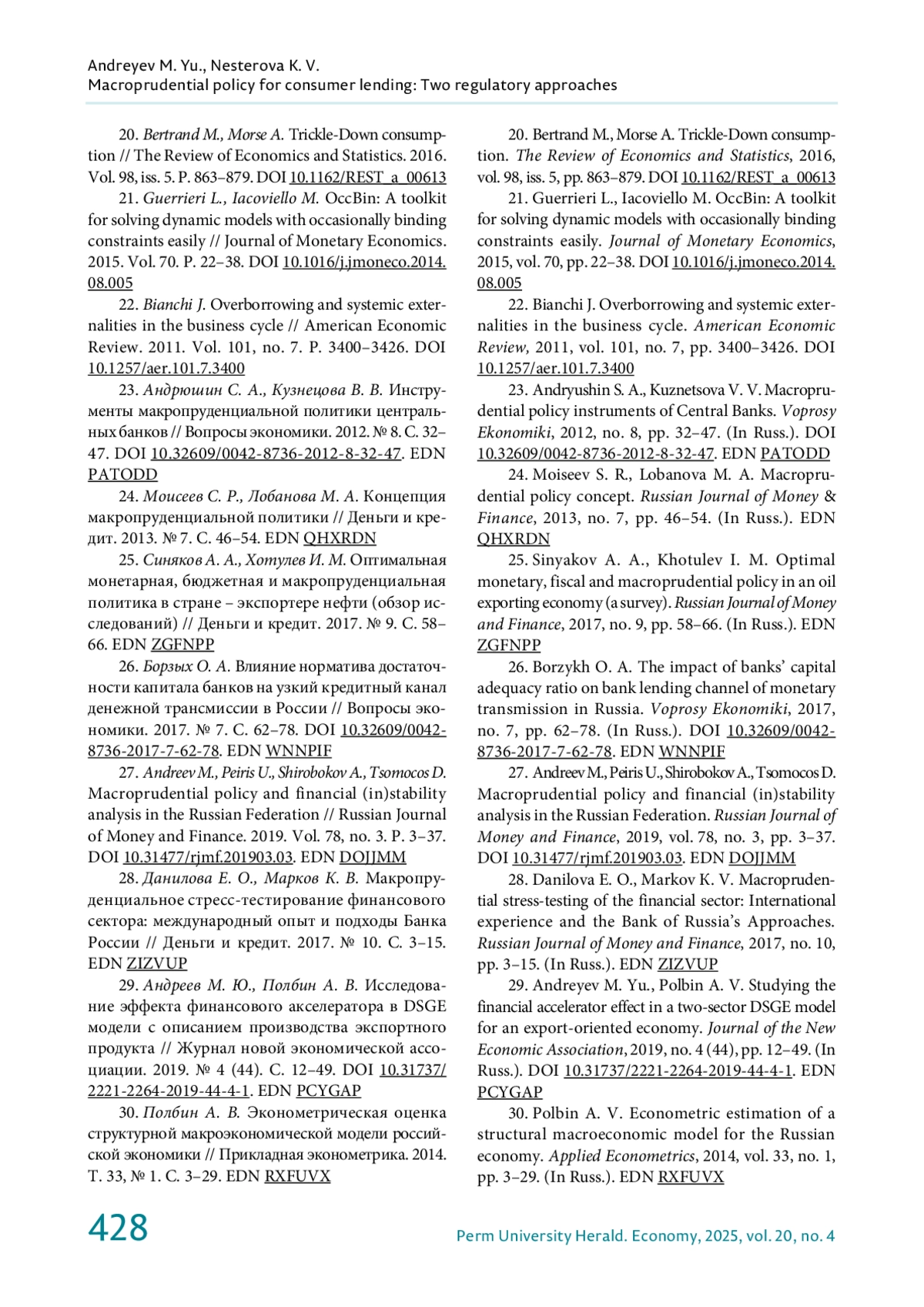
1. Akinci O., Olmstead-Rumsey J. How effective are macroprudential policies? An empirical investigation // Journal of Financial Intermediation. 2018. Vol. 33. P. 33-57. DOI: 10.1016/j.jfi.2017.04.001
2. Ayyagari M., Beck T., Martinez Peria M. S. Credit growth and macroprudential policies: Preliminary evidence on the firm level // BIS Papers Chapters. 2017. No. 91. P. 15-34. URL: https://clck.ru/3Q3Khz (дата обращения: 12.02.2025).
3. Gross M., Población J. Assessing the efficacy of borrower-based macroprudential policy using an integrated micro-macro model for European households // Economic Modelling. 2017. Vol. 61. P. 510-528. DOI: 10.1016/j.econmod.2016.12.029
4. Giannoulakis S., Forletta M., Gross M., Tereanu E. The effectiveness of borrower-based macroprudential policies: a cross-country analysis using an integrated micro-macro simulation model // ECB Working Paper. 2023. No. 2795. URL: https://clck.ru/3Q3Kg5 (дата обращения: 12.02.2025).
5. Van Bekkum S., Gabarro M., Irani R. M., Peydró J. L. The real effects of borrower-based macroprudential policy: Evidence from administrative household-level data // Journal of Monetary Economics. 2024. Vol. 147. Article 103574. DOI: 10.1016/j.jmoneco.2024.103574 EDN: DENAVE
6. Kozlovtceva I., Penikas H., Petreneva E., Ushakova Y. Macroprudential policy efficiency in Russia: Assessment for the uncollateralized consumer loans // Emerging Markets Review. 2022. Vol. 52. Article 100910. DOI: 10.1016/j.ememar.2022.100910 EDN: NJXDEW
7. Rubio M., Carrasco-Gallego J. A. Macroprudential and monetary policies: Implications for financial stability and welfare // Journal of Banking & Finance. 2014. Vol. 49. P. 326-336. DOI: 10.1016/j.jbankfin.2014.02.012
8. Kozlovtceva I., Ponomarenko A., Sinyakov A., Tatarintsev S. A case for leaning against the wind in a commodity-exporting economy // International Economics. 2020. Vol. 164. P. 86-114. DOI: 10.1016/j.inteco.2020.08.003 EDN: SJMHWE
9. Claessens S. An Overview of Macroprudential Policy Tools // Annual Review of Financial Economics. 2015. Vol. 7. P. 397-422. DOI: 10.1146/annurevfinancial-111914-041807
10. Catapano G. Borrower based measures analysis via a new agent-based model of the Italian real estate sector // Bank of Italy Occasional Paper. 2023. No. 822. URL: https://clck.ru/3QjHrw (дата обращения: 12.02.2025).
11. Carpantier J. F., Olivera J., Van Kerm P. Macroprudential policy and household wealth inequality // Journal of International Money and Finance. 2018. Vol. 85. P. 262-277. DOI: 10.1016/j.jimonfin.2017.11.009
12. D’Orazio P. Income inequality, consumer debt, and prudential regulation: An agent-based approach to study the emergence of crises and financial instability // Economic Modelling. 2019. Vol. 82. P. 308-331. DOI: 10.1016/j.econmod.2019.01.015
13. Chatterjee S., Corbae D., Nakajima M., Ríos-Rull J. V. A quantitative theory of unsecured consumer credit with risk of default // Econometrica. 2007. Vol. 75, iss. 6. P. 1525-1589. DOI: 10.1111/j.1468-0262.2007.00806.x
14. Chatterjee S., Gordon G. Dealing with consumer default: Bankruptcy vs garnishment // Journal of Monetary Economics. 2012. Vol. 59, Supplement. S1-S16. DOI: 10.1016/j.jmoneco.2012.10.021
15. Li W., Sarte P. D. US consumer bankruptcy choice: The importance of general equilibrium effects // Journal of Monetary Economics. 2006. Vol. 53(3). P. 613-631. DOI: 10.1016/j.jmoneco.2005.01.007
16. Antunes A., Cavalcanti T., Mendicino C., Peruffo M., Villamil A. Tighter credit and consumer bankruptcy insurance // CEPR Discussion Papers. 2020. No. 14330. URL: https://clck.ru/3QjHxU (дата обращения: 12.02.2025).
17. Kumhof M., Rancière R., Winant P. Inequality, leverage, and crises // American Economic Review. 2015. Vol. 105, no. 3. P. 1217-1245. DOI: 10.1257/aer.20110683
18. Gali J. Keeping up with the Joneses: Consumption externalities, portfolio choice, and asset prices // Journal of Money, Credit and Banking. 1994. Vol. 26, no. 1. P. 1-8. DOI: 10.2307/2078030
19. Markus C., Ruskin M. Keeping Up with the Joneses: Analyzing the Effect of Income Inequality on Consumer Borrowing // Quantitative Marketing and Economics (QME). 2005. Vol. 3. P. 145-173. DOI: 10.1007/s11129-005-0351-1 EDN: JWNPHF
20. Bertrand M., Morse A. Trickle-Down consumption // The Review of Economics and Statistics. 2016. Vol. 98, iss. 5. P. 863-879. DOI: 10.1162/REST_a_00613
21. Guerrieri L., Iacoviello M. OccBin: A toolkit for solving dynamic models with occasionally binding constraints easily // Journal of Monetary Economics. 2015. Vol. 70. P. 22-38. DOI: 10.1016/j.jmoneco.2014.08.005
22. Bianchi J. Overborrowing and systemic externalities in the business cycle // American Economic Review. 2011. Vol. 101, no. 7. P. 3400-3426. DOI: 10.1257/aer.101.7.3400 EDN: PHONNH
23. Андрюшин С. А., Кузнецова В. В. Инструменты макропруденциальной политики центральных банков // Вопросы экономики. 2012. № 8. С. 32-47. DOI: 10.32609/0042-8736-2012-8-32-47 EDN: PATODD
24. Моисеев С. Р., Лобанова М. А. Концепция макропруденциальной политики // Деньги и кредит. 2013. № 7. С. 46-54. EDN: QHXRDN
25. Синяков А. А., Хотулев И. М. Оптимальная монетарная, бюджетная и макропруденциальная политика в стране - экспортере нефти (обзор исследований) // Деньги и кредит. 2017. № 9. С. 58-66. EDN: ZGFNPP
26. Борзых О. А. Влияние норматива достаточности капитала банков на узкий кредитный канал денежной трансмиссии в России // Вопросы экономики. 2017. № 7. С. 62-78. DOI: 10.32609/0042-8736-2017-7-62-78 EDN: WNNPIF
27. Andreev M., Peiris U., Shirobokov A., Tsomocos D. Macroprudential policy and financial (in)stability analysis in the Russian Federation // Russian Journal of Money and Finance. 2019. Vol. 78, no. 3. P. 3-37. DOI: 10.31477/rjmf.201903.03 EDN: DOJJMM
28. Данилова Е. О., Марков К. В. Макропруденциальное стресс-тестирование финансового сектора: международный опыт и подходы Банка России // Деньги и кредит. 2017. № 10. С. 3-15. EDN: ZIZVUP
29. Андреев М. Ю., Полбин А. В. Исследование эффекта финансового акселератора в DSGE модели с описанием производства экспортного продукта // Журнал новой экономической ассоциации. 2019. № 4 (44). C. 12-49. DOI: 10.31737/2221-2264-2019-44-4-1 EDN: PCYGAP
30. Полбин A. В. Эконометрическая оценка структурной макроэкономической модели российской экономики // Прикладная эконометрика. 2014. Т. 33, № 1. С. 3-29. EDN: RXFUVX
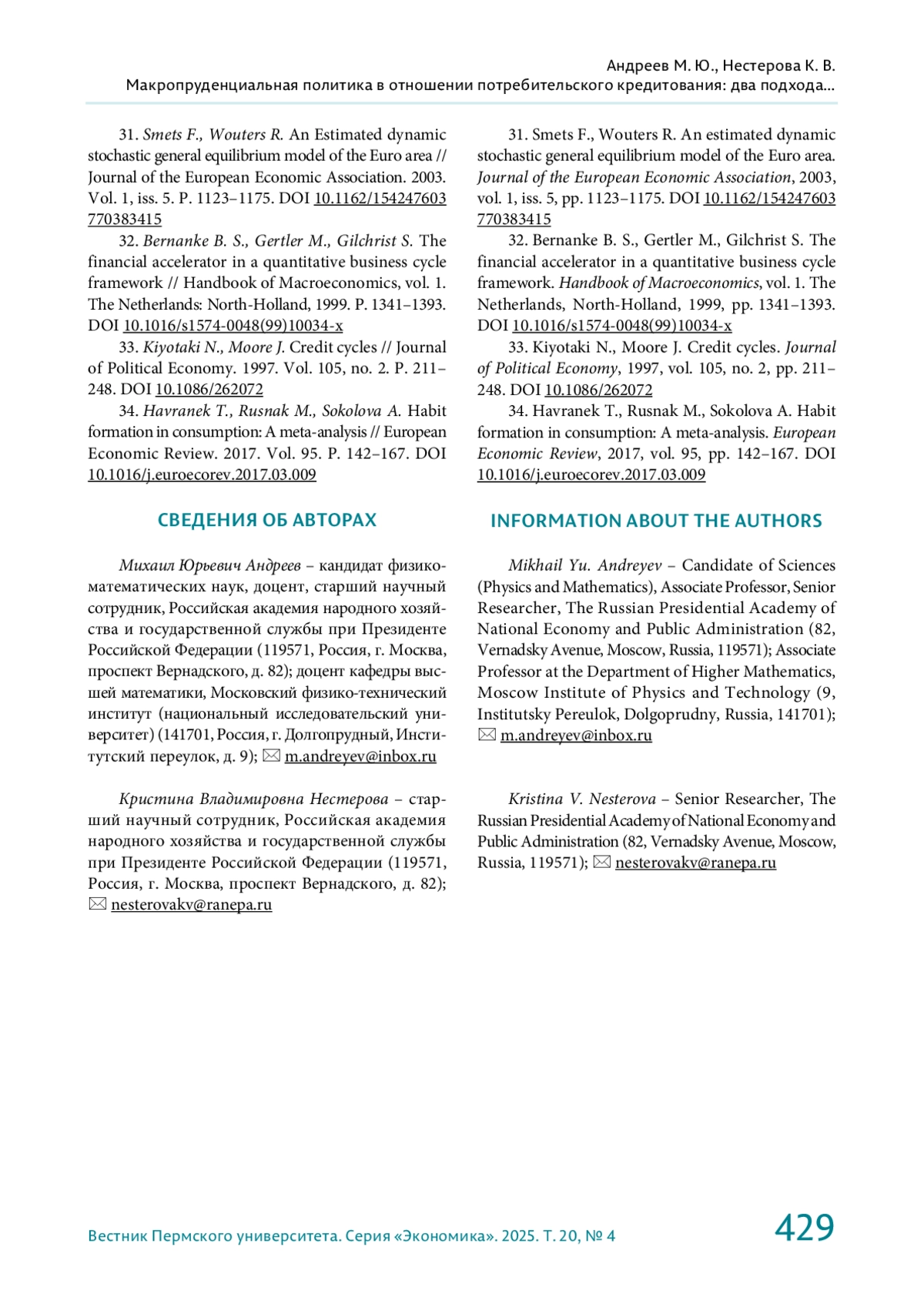
31. Smets F., Wouters R. An Estimated dynamic stochastic general equilibrium model of the Euro area // Journal of the European Economic Association. 2003. Vol. 1, iss. 5. P. 1123-1175. DOI: 10.1162/154247603770383415
32. Bernanke B. S., Gertler M., Gilchrist S. The financial accelerator in a quantitative business cycle framework // Handbook of Macroeconomics, vol. 1. The Netherlands: North-Holland, 1999. P. 1341-1393. DOI: 10.1016/s1574-0048(99)10034-x
33. Kiyotaki N., Moore J. Credit cycles // Journal of Political Economy. 1997. Vol. 105, no. 2. P. 211-248. DOI: 10.1086/262072 EDN: EMAKIN
34. Havranek T., Rusnak M., Sokolova A. Habit formation in consumption: A meta-analysis // European Economic Review. 2017. Vol. 95. P. 142-167. DOI: 10.1016/j.euroecorev.2017.03.009 EDN: YVOLNV