

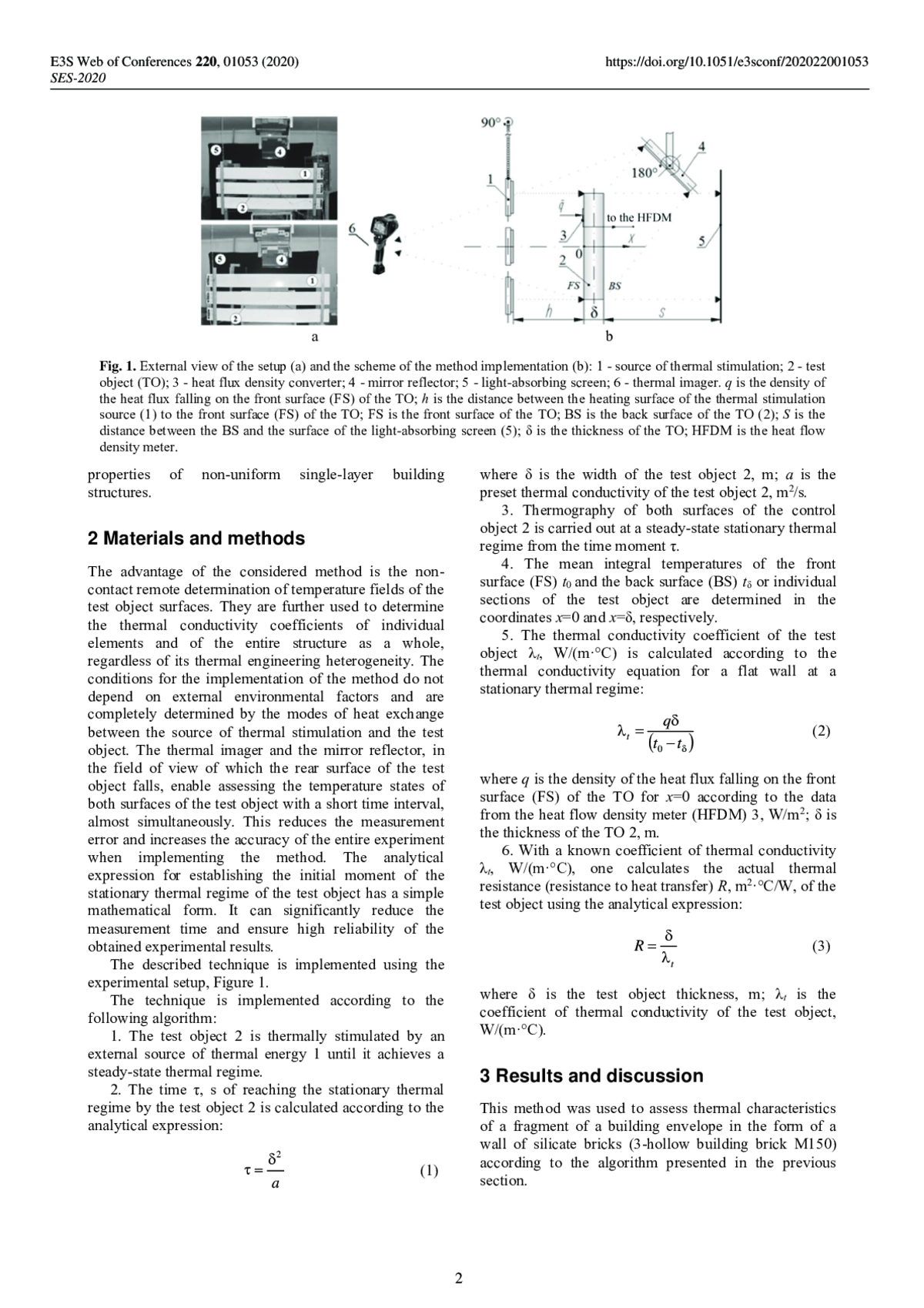
Thermal control (passive and active) is a non-destructive testing method. During passive thermal control, the test object is characterized by a temperature field formed during its operation. In active thermal control, the test object is additionally thermally stimulated. This technique is widely used in various areas of construction, energy, mechanical engineering, transport. This paper proposes a variant of active thermal non-destructive assessment of the thermal conductivity coefficient of building materials and products on the example of a fragment of a building structure made of silicate bricks. The test object is subjected to thermal stimulation by an external source of thermal energy before reaching a steady-state thermal regime. Thermography of the test object surfaces is carried out. The average integral temperatures of surfaces or individual sections of the test object are calculated. The coefficient of thermal conductivity of the test object is determined, which is used to calculate its thermal resistance (resistance to heat transfer). After that, the coefficient of heat transfer is calculated. The method was implemented in laboratory conditions. It can be used in natural and operational conditions for accurate and quick determination of the key thermophysical properties of building materials and products.
Термоконтроль (пассивный и активный) - это метод неразрушающего контроля. При пассивном термоконтроле объект контроля характеризуется температурным полем, формирующимся в процессе его эксплуатации. При активном термоконтроле объект контроля дополнительно подвергается термической стимуляции. Эта техника широко применяется в различных областях строительства, энергетики, машиностроения, транспорта. В данной работе предлагается вариант активной термической неразрушающей оценки коэффициента теплопроводности строительных материалов и изделий на примере фрагмента строительной конструкции из силикатного кирпича. Тестируемый объект подвергается термическому воздействию с помощью внешнего источника тепловой энергии до достижения стационарного теплового режима. Выполняется термография поверхностей тестируемого объекта. Рассчитываются средние интегральные температуры поверхностей или отдельных участков тестируемого объекта. Определяется коэффициент теплопроводности исследуемого объекта, который используется для расчета его термического сопротивления (стойкости к теплопередаче). После этого рассчитывается коэффициент теплопередачи. Метод реализован в лабораторных условиях. Он может быть использован в естественных и эксплуатационных условиях для точного и быстрого определения ключевых теплофизических свойств строительных материалов и изделий.
Предпросмотр статьи




Идентификаторы и классификаторы
- SCI
- Строительство
- Префикс DOI
- 10.1051/e3sconf/202022001053
- eLIBRARY ID
- 44884491
Features and results of assessment the thermal conductivity of building materials and products by the active method of thermal non-destructive testing / D. Karpov, M. Pavlov, L. Mukhametova, A. A. Mikhin // E3S Web of Conferences, Saint-Petersburg, 29–30 октября 2020 года. Vol. 220. – Saint-Petersburg: EDP Sciences, 2020. – P. 01053. – DOI 10.1051/e3sconf/202022001053. – EDN FPCPUR.
Features and results of assessment the thermal conductivity of building materials and products by the active method of thermal non-destructive testing / D. Karpov, M. Pavlov, L. Mukhametova, A. A. Mikhin // E3S Web of Conferences, Saint-Petersburg, 29–30 октября 2020 года. Vol. 220. – Saint-Petersburg: EDP Sciences, 2020. – P. 01053. – DOI 10.1051/e3sconf/202022001053. – EDN FPCPUR.
Features and results of assessment the thermal conductivity of building materials and products by the active method of thermal non-destructive testing / D. Karpov, M. Pavlov, L. Mukhametova, A. A. Mikhin // E3S Web of Conferences, Saint-Petersburg, 29–30 октября 2020 года. Vol. 220. – Saint-Petersburg: EDP Sciences, 2020. – P. 01053. – DOI 10.1051/e3sconf/202022001053. – EDN FPCPUR.
Если у вас возникли вопросы или появились предложения по содержанию статьи, пожалуйста, направляйте их в рамках данной темы.